
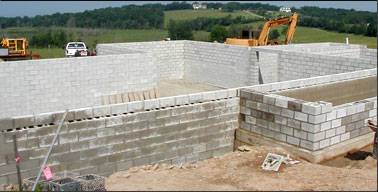
Figure 1 - Concrete block used to construct basement walls
The type of fastener used to hold the building or structure to the pad is determined by whether the pad is in place or will be poured.
Concrete block is an energy efficient building material as it has limited thermal transmission creating reasonably high R
numbers.
Concrete is a versatile product that can is manufactured using forms, hence there are many specialty shapes and sizes available. The information provided here is based on the standard grey concrete block.
The standard concrete block configurations are:
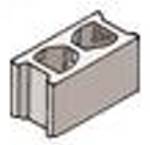
Two Core Concrete Block
8″ x 8″ x 16″
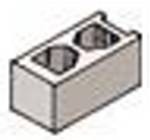
Two Core Concrete Block End
8″ x 8″ x 16″
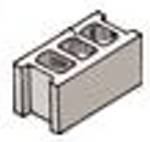
Three Core Concrete Block
8″ x 8″ x 16″
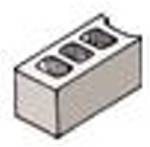
Three Core Concrete Block End
8″ x 8″ x 16″
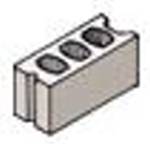
Three Core Concrete Block Steel Sash
8″ x 8″ x 16″
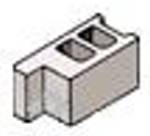
Three Core Concrete Block Wood Sash
8″ x 8″ x 16″
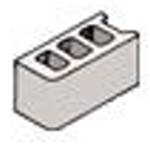
Three Core Concrete Block Bullnose
8″ x 8″ x 16″
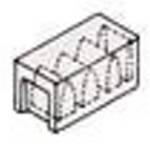
Three Core Concrete Block Cap
8″ x 8″ x 16″
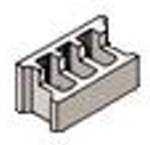
Three Core Concrete Block Header
8″ x 8″ x 16″
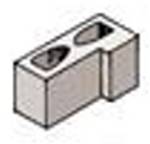
Two Core Concrete Block Return or Corner Angle
8″ x 8″ x 16″
The most common block widths are 8 and 10 inches. However, concrete blocks can be provided in 4, 6 and 12 inch widths.
The specification of concrete block allows for a 3/8″ mortar fill. Hence a block that is specified as 8″ x 8″ x 16″ will actually measure 7 5/8″ x 7 5/8″ x 15 5/8″
Half blocks are also available for ends of runs.
Concrete blocks require a footing, as shown in Figure 2 that is below the frost line or in the case of a barbecue or similar structure on a large concrete pad.
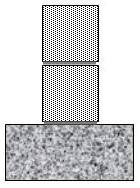
Figure 2 - Concrete blocks on footing
The footing should be at a minimum as deep as the wall is thick and twice as wide as the wall is thick. Hence a footing for a wall that is using 8″ x 8″ X 16″ concrete blocks should have a minimum depth 8″ and a minimum width of 16″. If you were using 10″ x 10″ x 16″ concrete blocks the minimum dimensions of the footing would be 10″ deep and 20″ wide.
The following chart will aid you in determining the quantity of concrete blocks required and the mortar needed for your specific project.
The quantity of concrete blocks required is relative to the square footage of the wall you are building and the height and length of the concrete blocks chosen, as shown in Table 1.
Table 1 - Quantity Of Concrete Blocks RequiredBased on 100 square feet of wall with no openings. |
||
Concrete Block Height |
Concrete Block length |
Number Of Concrete Blocks Required |
4″ |
16″ |
225 |
8″ |
16″ |
112 1/2 |
Table 2 provides the amount of mortar required for 100 square feet of wall area and for 100 concrete blocks.
Table 2 - Amount of Mortar Required For A Concrete Block Wall |
||
Concrete Block Height |
Mortar Required For 100 Square Feet Of Wall Area |
Mortar Required For Each 100 Blocks |
4″ |
13 1/2 cubic feet |
6 cubic feet |
8″ |
8 1/2 cubic feet |
7 1/2 cubic feet |