
A whole house fan, see Figure 1, is a large fan that mounts in the ceiling at the highest point of the interior of the home, draws outdoor air through the home and exhausts into the attic space, providing a relatively inexpensive means to reduce temperatures in a home.
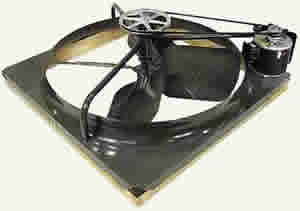
Figure 1 - Whole house fan
One should remember that the cooling ability of a whole house fan is subject to the outdoor temperature and humidity as the fan itself does not provide any cooling or dehumidification. It brings in outdoor air, which means that windows must be open and should you live in an area with a lot of dust, this may be a definite disadvantage to a whole house fan.
If you live in a climate where outdoor temperatures are reasonable, at least during a number of months of the year, then a whole house fan can be beneficial in the reduction of energy expense during those months.
The initial equipment cost of a whole house fan is similar to that of a single room window air conditioner, however, the operating costs are substantially less. A window air conditioner can cost as much as $0.25 per hour to operate where as a whole house fan should not cost more than $0.05 an hour to operate and an efficient unit could operate for as little as $0.01 per hour. The cost to operate a central air conditioning system for an average size home is $0.10 per hour, but the upfront equipment cost starts at $2,000.
One advantage over other cooling systems is that a whole house fan can remove unwanted odors from a home very quickly.
One large disadvantage is that the fan provides an non insulated access to your attic, which if not properly sealed in the winter can cause large amounts of heat to escape from the living quarters into the attic.
Sizing A Whole House Fan:
Ceiling fans can be mounted in 3 positions:
For a whole house fan to operate correctly it must, like any other ventilation device, be sized and installed correctly to be of any benefit.
- Calculate the volume of the living space in your house this includes hallways and excludes attic space, garage and unfinished basements.
- The proper sized whole house fan will be between 50% and 100% of the cubic foot volume of the home in CFM (cubic feet per minute). In the example, you would require a whole house fan between 4,800 CFM and 9,600 CFM.
The volume calculation for a single story home is: length of house × width of house × height of living space. Remember if you have a two story or split level house you must calculate for all of the living space as the calculation shown would only suffice for single story homes. A two story house would require twice as much as a single story house.
Example: A single story house that is 40' long, 30' wide and has 8' ceilings has a volume of 9,600 cubic feet.