home improvement

House Foundations - Part 1

Subscribe to our diy, home improvement newsletter.

home improvement diy newsletter

Home

Blog

New Pages

Main Index

New Product Showcase

Gardening

Flooring

Bathroom

Kitchen


Home Improvement Categories

A

Additions

Air Cleaners

Air Conditioning

Air Quality

Appliances

Articles

Asphalt Driveway

Attic


B

Backsplash

Basement

Bathroom

Before & After Pictures

Blinds

Books

Building Permits


C

Cabinets

Calculators

Carpet

Caulking

Ceilings

Concrete

Condensation

Construction

Contractor

Converters

Cork

Counter Tops


D

Decks

Demolition

Design / Layout

Doors

Driveways

Drywall


E

Electricity & Electrical

Environmental

Exterior


F

Fans

Faucets

Fences

Financing

Fireplace

Fixtures

Flooring


G

Gardening

Garage

Glass Blocks


H

Heating

Home Automation

Hot Water Systems

Humidity


I

Insulation

Insurance


K

Kitchen


L

Laminate Flooring

Landscaping

Lead Based Paint

Lighting

Luxurious Materials


M

Magazines

Mold & Moisture


P

Painting

Patio

Plans - Free

Plumbing

Publications


R

Roofing

Roofs


S

Safety

Security

Sinks

Skylights

Stairs

Steel Studs

Structured Wiring


T

Tile - Flooring

Toilets

Tools


V

Vacuums - Central

Ventilation

Vinyl Flooring


W

Wallpaper

Walls

Window Decor

Windows

Wood Flooring


  Find a Contractor

Home Design Studio for Mac


How To Build A House, Garage or Addition Foundation

Part 2         Part 3

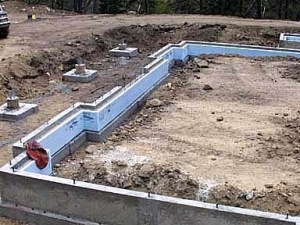
The foundation is the part of a building that supports the load of the house.  In construction the term "foundation" generally applies to all of the building segments that are constructed beneath the framing of the first floor including all of the walls, piers, columns, pilasters and other supports.


poured concrete foundation


The Two Most Common Types Of Foundations

Spread Foundations

Pile Foundations
spread foundation construction pile foundation construction

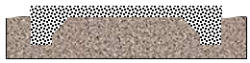
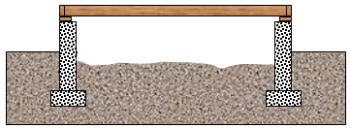
The most popular of all the foundation alternatives, spread foundations take the weight of the structure and distribute the load to a stable soil base by means of individual foundations.
Pile foundations transmit the weight of the building through soil that cannot support the load to a solid base or strata.
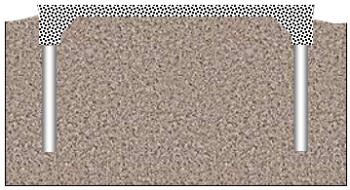
This article will not deal with the construction of a pile foundation.  Pile foundations in residential properties only occur in wetland areas and where construction is occurring on reclaimed land or very close to lakes or oceans.  Pile construction is definitely not something that the home handyman should even consider.  It requires specialized engineering and heavy equipment.

Spread Foundations

The Three Most Common Types Of Spread Foundations

Slab On Grade

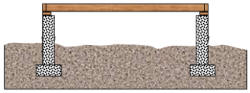
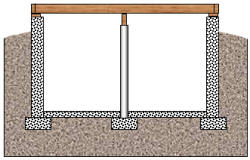
Crawl Space Full Basement
slab on grade foundation crawl space foundation fulll basement foundation


Slab On Grade Foundations

The Three Most Common Types Of Slab On Grade Foundations

One Integral Unit

Supported By Foundation Wall Independent
slab on grade with integral foundation slab on grade with supporting foundation wall slab on grade with independent foundation


The following procedure details the construction methodology for a slab on grade foundation:

  1. Site Clearance:  As a general rule, there is little if any excavation required to pour a slab on grade foundation.  Brush and trees are removed by a small bulldozer and to spread any fill that may be necessary for leveling.

  2. Lay Out Foundation:  Install batter boards and strings to define the outline of the foundation.  The batter boards that are tied to the stakes should be no less than 8" above final grade.

  1. Install The Form Boards:  The forms that are used to pour the concrete are generally 2 X material and are aligned with the strings.  Some contractors will use metal forms, especially if they are constructing a number of duplicate foundations.

proper bracing for a concrete formThe forms must be held in place securely as there is a tremendous amount of weight in wet concrete.  This is an area where many home handymen skimp, with the result that the forms bend or , even worse, break open before the concrete has cured.

The proper method to secure the concrete form is to place a 2 X 4 stake adjacent to the form board.  Another 2 X 4 stake is driven at an angle approximately 3' from the form board.  A board called a kicker is then used to tie the two 2 X 4 stakes together.  The braces should be placed a minimum of every 4' around the perimeter of the form.

Before pouring the concrete, test the form.  If you can bend it or move the form, at all, by pushing or pulling on it, you must add additional bracing.

Continued..........


Manufacturers, Retailers, Dealers - Advertise on this page!

house construction

Contact

addition foundation

house foundation

copyright 2006/8 - all rights reserved

garage foundation