
On demand or tankless hot water heaters have been in use in Europe and Asia for over 40 years, although the vast majority have been fueled by natural gas or propane and were installed in locations within the home that required hot water, primarily kitchens and bathrooms, as they did not use a central hot water storage tank for an entire home.
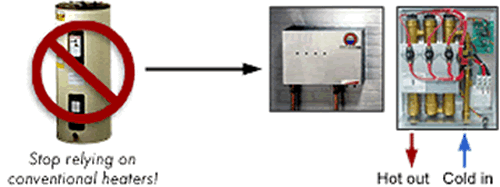
Figure 1 - Hot water tank replaced with a tankless system
In North America, electrically powered, on demand systems are making a strong entry into the residential hot water heater market.
These systems have the capacity to replace a conventional tank hot water system without the need for multiple units.
Table 1 provides a comparison between conventional hot water heaters that utilize tanks and tankless or on-demand hot water heaters.
Table 1 - Tankless, On Demand Hot Water Heater Benefits |
|
Tanks |
Tankless |
Continually heating the water. |
Heats water as and when required. |
Lasts between 2-10 years, depending on initial quality and mineral content of water. |
+25 year life expected. |
Efficiency decreases from a start of 80% in the first year. |
98% efficiency throughout operational life. |
With minerals settling to bottom of tank corrosion takes place and leaking occurs. |
No Leaking |
Energy Factor of 0.58 average |
Energy factor of 0.98 |
Instant, on-demand hot water means that water is heated instantly, as it is required, unlike conventional tank water heaters, that in order to supply hot water to the home continuously heat water 24 hours per day, 7 days a week. This means that you pay for the energy to heat water that is never used. If an on-demand system is sized properly to meet your usage requirements and climate you will never run out of hot water, unlike conventional tank water heaters which often run out of hot water when demand is high.
Retrofitting an on-demand hot water system is relatively easy, as far as plumbing is concerned, as the system itself is about the size of a briefcase, it can easily fit in the location that the current hot water tank occupies. However, electrically powered on demand hot water systems require enormous amounts of electricity, all be it for very short periods of time, the electrical service entering the home must be capable of supplying the necessary power.
For an average size home this means that with a 115VAC nominal electrical system you require a minimum of 120 amp circuit and for 230VAC nominal systems it is a minimum of a 60 amp circuit. At a minimum you will require a 200 amp incoming service to your home.
An average family of 4 in the US, will consume approximately 100 gallons of hot water each day. Using an on demand system versus an electric powered tank system will save, on average $250.00 per annum and compared to a gas hot water tank a saving of $150.00 per annum could be realized. As the price of a kilowatt hour of electricity increases the homeowners savings increase.