
Christmas season is upon us and as we commence to decorate the inside of our homes with lights it is important to remember that overloading electrical circuits is a common occurrence at this time of year.
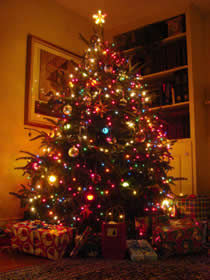
Many people around the world will have their Christmas festivities ruined due to house fires caused by overloading electrical circuits. In your home, electrical outlets (receptacles) are connected to other electrical outlets (receptacles) and lighting. In most cases the most current that an individual circuit can handle is 15 amps.
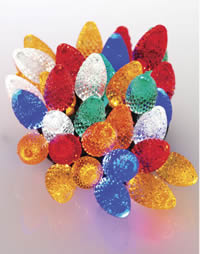
Figure 1 - The newer LED style Christmas lights draw less than 1% of the older style.
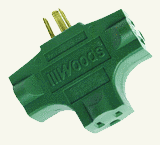
Figure 2 - Cube tap.
Older style Christmas lights can require as much as 7 watts per bulb.
If you use a lot of Christmas lights it is wise to consider using the newer style LED bulbs, as shown in Figure 1. Besides that they are safer, the cost to power them is greatly reduced.
Selection of LED indoor Christmas lights.
Besides the bulbs themselves, another common mistake is to use a multitude of cube taps, as shown in Figure 2, in order to power the lights. Electrical receptacles are designed to handle 2 male plugs. Cube taps which allow 3 or more cords to be connected to each of the two electrical sockets of a outlet (receptacle) can create a hot spot.
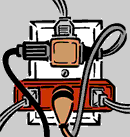
The picture on the upper right is an electrical connection that is definitely not recommended. If you must use cube taps make sure that they are approved to for the current and voltage levels that you are using.
Inspect all of the electrical cords to ensure that they are not frayed or damaged anywhere along their length. Also check your extension cords and ensure that they are properly rated for the electrical load they are to carry.
Extension cord placement is also important. Try not to run extension cords across areas where adults and children will walk. Running cords, even though the distance may be longer, around the perimeter of the room is a much safer method.
Do not leave lights or other ornaments powered on, if you are leaving the house unattended. Your neighbors will love to see your Christmas tree all lit up through the window. They will also stand and watch as the firemen attempt to put out the fire in your home.
Electrical fire safety is something that should be watched for 365 days a year. Never is it more important than during the Christmas holiday season.
Have a safe holiday season!