
"Protect your Home, Hurricane and Flood preparation tips to help you avoid disasters from striking"
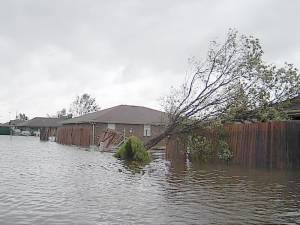
Figure 1 - Flood damage
According to a survey, more people feel that owning a house is more costly than renting an apartment. Practical people say that this is due to the fact that homeowners have to face not only maintenance costs but also taxes and interest if the house was purchased through a loan. Some people also claim that it is difficult to raise the money needed for a down payment and this is complicated further by bad credit. People who live in the city feel that having their own home is a liability especially when they are single and are living in their prime.
Despite these disadvantages in purchasing a home, a lot of people still purchase their own home. People who already have their families are among the best clients of real estate agents. Having a stable and secure home is one of the basic needs of children who are growing up. Having close friends in the community is important for your precious ones as this helps build up their confidence. With their children having friend’s parents know they can trust, it is much easier to raise kids. A house is an investment, both emotionally and financially and as a homeowner, you probably have taken out insurance to protect your home.
Unfortunately, not all homeowner’s insurance completely cover damages from hurricanes and other natural calamities. If you do not take the proper precautions, you might lose the memories you’ve built with your house, not to mention the thousands of dollars you’ve invested! Even if you don’t live in hurricane-prone areas such as Florida, hurricane awareness and preparation is important to prevent panic, which could magnify the problems during natural calamities such as storms and hurricanes. While it is true that no house is hurricane proof, there are some steps that homeowners can do to protect their homes against hurricanes and the almost inevitable flooding that follows.
The A-B-C of Hurricane Safety
Preparing homes for hurricanes is as easy as A-B-C: anchor, brace and cover.
Anchor:
- Remember that anything in the yard can become airborne. Bring in to the house everything that can harm people and properties, you can also ask the neighbors to do the same to ensure the safety of everyone.
- Flying gravel and rock can damage properties such as your windows and the glass of your car. To minimize the damage, you can use fire-treated shredded bark for your landscaping.
- Anchor the exterior walls of the house to the foundation to ensure that these won’t be carried by the strong winds.
Brace:
- Ensure that all head bolts for your doors extend at least one inch into the frame as it is usually the doors which get dislodged during a storm, causing greater damage to the home, if not other people’s properties.
- Get center supports for the garage door.
- Reinforce the framing and gable with vertical and horizontal beams.
Cover:
- Use impact-resistant shutters to cover large windows and doors. If you have the budget, you can replace your windows with tempered glass that can withstand wind pressure of 120 mph, and impact-resistant laminated door systems.
- It is best to install a roof which is rated for hurricane-force winds.
- Make sure that all seams and cracks in the home are filled with waterproof material such as caulk.