
Paver bricks have become a very popular addition to many landscaping projects (Figure 1). Made by molding concrete in forms, the pavers come in a variety of textures, colors, shapes, and sizes providing the ability to match and compliment brick and stone veneers used elsewhere on adjacent buildings.
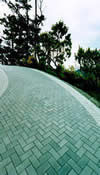
Figure 1 - Driveway with paver bricks
The numerous physical designs allow for a lot of creativity.
Paver bricks, paving stones, concrete paving bricks or pavers as they are commonly called, are used on commercial, industrial and residential properties.
As a construction material, they have many advantages:
- Relatively easy to install
- Can be put into service immediately
- No special tools required (although a vibrating compactor aids in preparing the base and a paver cutter makes clean fast work of sizing the units)
- A single individual can accomplish installation
- Project can be completed over extended periods of time with no evidence
- Can be easily removed and reinstalled if underground service access is required.
By choosing different shapes, textures, sizes, and colors, the property owner can easily express their own creativity in design. Figures 2, 3 and 4 show some typical uses of concrete pavers.
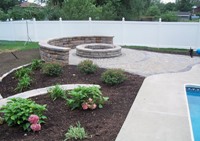
Figure 2 - Paving bricks used around a swimming pool and to highlight a garden
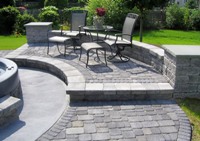
Figure 3 - Paving bricks used to create a patio, walkway and retaining wall
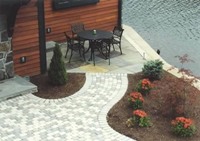
Figure 4 - Paving bricks used as a walkway, patio and defines plantings
Paving bricks are used in a host of applications:
- Driveways,
- Sidewalks,
- Retaining walls
- Patios,
- Walkways,
- Pool Decks,
- Roadways
Along with the variety of applications, numerous design and layout enhancements can be achieved with a specific property, as shown in Figures 5, 6 and 7.
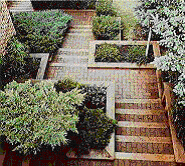
Figure 5 - Paving bricks used as steps, flower boxes and retaining walls
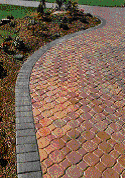
Figure 6 - Grey and red paving bricks used to create a driveway
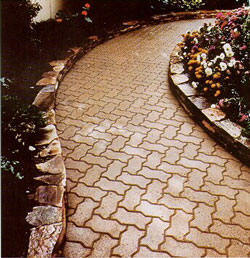
Figure 7 - Winding walkway uses interlocking paving bricks against a stone retaining wall
- Select pavers that complement the building façade. As a color recommendation, it is suggested that the pavers be a couple of shades lighter than the building so that the viewer is not visually drawn toward the pavers instead of the structure.
- You can add warmth to wood and stone homes with the installation of brick pavers.
- Combining pavers with different textures creates visual appeal.
- Do not lay pavers in excessively long straight rows. If the project requires a long straight run, it is wise to create a visual break by placing the edge pavers in a parallel pattern and then to use a basket weave pattern on the area between the edge pavers.
- With a Victorian style home, use the arches within the overall home design as a pattern for laying the curves of the pavers.
- As Colonial homes are basically square, the best visual effects are created with the use of brick shaped pavers rather than pavers with intricate shapes and forms.
- Homes that have brick veneer are best served with pavers that are a lighter than the home’s brick façade. As an alternative, with a brick veneered home you could use cobblestones in place of concrete pavers.
Pavers, as a product, are heavy and because of that, concrete pavers are generally fabricated on a regional level in order to reduce shipping costs. This means that specific pavers that are available in one region may not be available elsewhere.
Paving bricks are made in two thicknesses. A 2.375 inch paver for residential applications and where vehicle traffic is limited and a 3.125 inch paver that is generally used in commercial and road applications.
Quality pavers manufactured in the US are made to ASTM C 936 standard which spells out compression strength, absorption, and freeze/thaw characteristics. It is to your long-term benefit to verify that the manufacturer of the concrete pavers, that you are considering buying, does in fact produce to the ASTM specification.
As with many products, pavers are manufactured in batches and will have lot numbers associated with each batch. Between batches, it is not unusual to have color variations. When laying more than one pallet of pavers it is suggested that you alternate individual pavers from each pallet and hence this will blend the color variations in the finished project.
Additional information on Paving Brick Installation Techniques and Information