
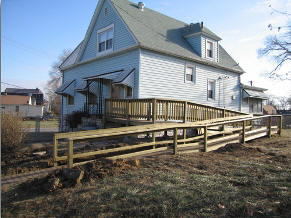
Figure 1 - Wheelchair ramp
It is impossible to provide a definitive set of building plans for a wheelchair ramp, because every wheelchair ramp has to be built to a specific height from ground level and the wheelchair ramp must accommodate the realities and physical impairments that are part of the property.
There are three basic design factors for a wheelchair ramp:
- The slope of the wheelchair ramp should not be less than 1:12. Which means that the wheelchair ramp should not rise more than 1 inch for every 12 inches of ramp length, as shown in Figure 2.

Figure 2 - Rise of wheelchair ramp should be a maximum of 1 inch for every 12 inches of ramp (1:12)
- For every 30 inches (maximum), of wheelchair ramp rise there must be a landing. The wheelchair ramp landing must be a minimum of 5 feet long, as shown in Figure 3.

Figure 3 - Wheelchair ramp - ratio of ramps and landings
- The wheelchair ramp should be a minimum of 36 inches wide.
Building a wheelchair ramp uses the same basic construction techniques that are used for building a deck.
Wheelchair Ramp Layout:
- Determine the height of the entry door that the wheelchair ramp is to provide access too.
- Because of variations to the level of the terrain that the ramp must cross in order to get to the entry door, and the fact that most landscaping slopes away from a home. Determining the height of the ramp can, in many cases, requires some trial and error.
- One of the best tools to help in determining the height of the access entry door is a laser level (Figure 4). Estimate the height of the bottom of the entry door and using the fact that the ramp can have a maximum rise of 1 foot for every 12 feet of distance, take the laser level to the estimated end position of the ramp.
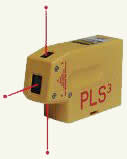
Figure 4 - Laser level
- As an example, if you estimate that the bottom of the access door is 20 inches high, you would need 20 lineal feet of ramp. Pace out 20 feet from the door and set-up the laser level, as shown in Figure 5. Check the measurement from the laser level to the ground and that would be your actual rise.
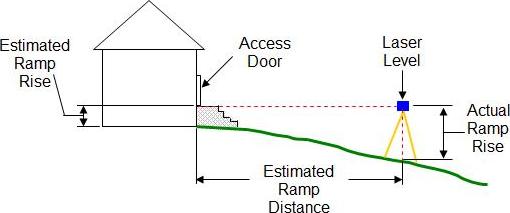
Figure 5 - Estimating wheelchair ramp rise and length
- As you can see in Figure 5, there can be a substantial difference between the actual ramp rise, almost twice as much, and the estimated ramp rise, in this case due to the fact that the landscape slopes away from the home. If you extended the ramp, you probably couldn't win as the landscape slopes away at a greater ratio than 1:12 you would never be able to build a straight ramp long enough to reach the access door.
- Another method would be to just measure the slope of the landscaping, as shown in Figure 6. If it exceeds the ratio of 1:12 you know that a wheelchair ramp cannot be constructed in a straight manner.
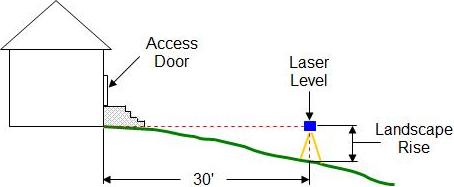
Figure 6 - Calculating the slope ratio of the landscaping
- Of course, the wheelchair ramp does not have to be built in a straight line from the access entry door. It can be constructed in an "L" shape, a "U" shape or combinations thereof.