logo

Bathroom Plumbing

Bathroom Plumbing Supply & Drainage Systems - Part 2

Part 1

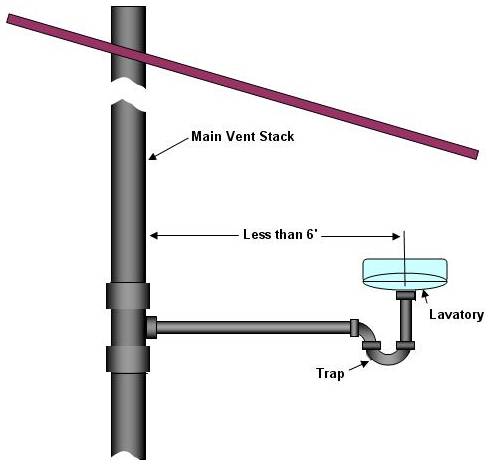
For proper and safe operation, at a minimum venting should be installed if the fixture is more than 6 feet away from the vent pipe connection. Figures 1 and 2 provide examples of proper venting (click on picture for larger view):

lavatory drain if within 6 feet of vent stack

Figure 1 - With bathroom fixture less than 6 feet from the vent stack, there is no need to create a secondary vent connection to the stack.
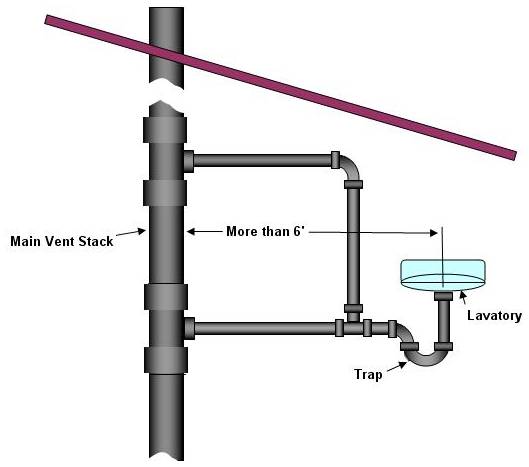
lavatory venting exceeding 6 feet from vent stack

Figure 2 - With the bathroom fixture farther than 6 feet from the vent stack a secondary connection should be made.

The same venting scenario applies to bathtubs, showers and toilets as shown in Figure 3.
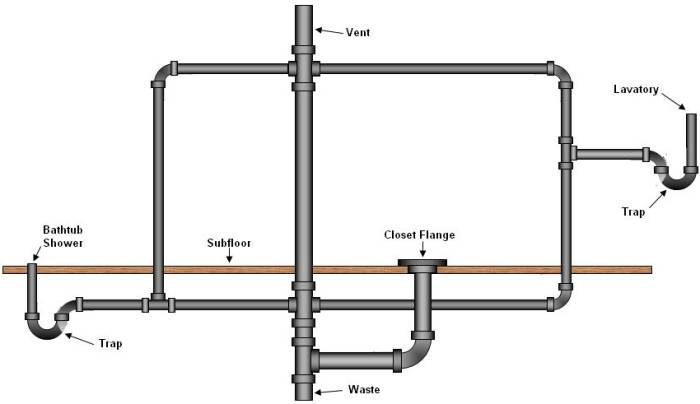
bathroom drain plumbing layout includes venting and traps

Figure 3 - Bathroom vent pipe diagram

Traps:

trap preventing sewer gas from entering home

Figure 4 - Filled drain trap prevents sewer gas from entering the home.

trap allowing sewer gas from entering home

Figure 5 - Empty drain trap allows sewer gas to enter the home.

corroded galvanized piping

Figure 6 - Corroded galvanized water pipes

water piping using a Tee to stop water hammering

Figure 7 - Water piping using a Tee to stop water hammering

foam water pipe insulation

Figure 9 - Foam water pipe insulation

The drain traps installed on all drainage lines going to all plumbing fixtures with the exception of the toilet are critical for the health and comfort of your family. The trap "traps" water which in turn prevents sewer gases from entering the living quarters of your home, as shown in Figures 4 and 5.

The toilet has its own water trap molded into the porcelain bowl section.

Note: If you have sinks, toilets, showers and/or bathtubs that are not used often, water should be placed down the drain (toilets flushed) every 30 days. The water in traps will evaporate over time, by pouring water down the drain or flushing the toilet you replace any water that may have evaporated preventing sewer gas from entering the home.

Water Supply:

The water supply lines are relatively easy to install compared to the drainage and vent piping. Because they can be installed in any direction, with bends and loops they can easily avoid any obstacles such as the drainage lines. There are a few items to consider during the installation of the hot and cold water lines.

Many older homes used galvanized piping for the water supply. Over time, galvanized water pipes corrode and develop leaks, as shown in Figure 6.

Galvanized pipes were replaced by copper. Copper piping will last forever.

Now many homes have the internal water piped in plastic pipes (check your building codes, in some areas plastic cannot be used in others plastic can only be used for cold water).

While plastic has the advantage that it is easy to install, I prefer to stick with copper piping as I have more confidence in the connections and in the copper pipes ability to deflect most nails.

water shut off valve

Figure 8 - Water shut off valve

Install shut-off valves, as shown in Figure 8, in convenient access areas for all hot and cold water lines just before the connection to the faucets or toilet tank. The shut-off valves come in a variety of configurations and pipe connections. By having individual shut-off valves making repairs, replacing washers and faucets and replacing toilet tank valves becomes a relatively easy project.

Note: As a preventive maintenance measure it is wise to turn your valves off and on once a year. Valves are not used often, but when needed in order to accomplish a repair they are invaluable. Valves that are not used will end up with heavy concentrations of calcium on the inner valve stems, making them difficult to close. By turning them off and on once a year you will ensure that they are available to work when you need them.

Although not a necessity, I recommend that all water pipes be covered with a foam insulation. The foam insulation keeps the hot water from dissipating its heat through the copper piping, hence saving you energy. Foam insulation also reduces the noise generated when the water is travelling through the pipes. The insulation is relatively inexpensive and it is not something that can be easily added at a later date.

Bathroom Drainage & Venting System:

Not providing proper and adequate venting is usually the biggest mistake that the home handyman makes when installing or moving parts of a drainage system.

Continued......

Share |