
Causes
Why Is The Humidity In My Home High?
How Much Moisture Can Air Hold?
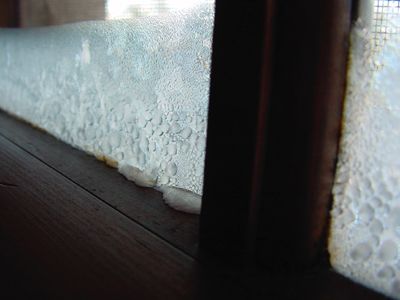
Figure 1 - Condensation on window
Condensation that forms on windows and other surfaces in your home can cause serious damage to window sills, trim and frames, plaster, drywall, wood flooring, and internal wall studs. Most individuals believe that because the see the condensation on the window itself, that it must be the window or the method of installing the window that is creating the problem. This couldn’t be farther from the truth in 99% of the cases. Humidity will condense on any surface that is at a lower temperature than the air. If you see condensation forming on windows, there is also condensation forming on walls and other surface areas in your home. Condensation problems that are not corrected can lead to major internal wall damage.
Condensation is created when air is saturated with excess water, which we feel as an increased level of humidity. As the air cannot hold the excess water it disposes of it by condensing it on any convenient surface that has a lower temperature than the air itself.
Why Is The Humidity In My Home High?
The air in our homes picks up water from numerous sources:
- A family of four will add a half pint of water to the air every hour through normal breathing and perspiration.
- Four to five pints of water per day will be added through normal cooking routines.
- Bathing will add a half pint of water on each occurrence.
- Dishwashers exhaust upwards of two pints every time they are used
- One to two pints will be absorbed by the air for each load of washing.
- Clothes dryers can put two to three pints of water into the air on each load.
- Inadequate insulation in crawl spaces allows the water within the soil to penetrate the home.
- Having humidifiers set to add high levels of moisture to the air.
Excess moisture is often a problem in new homes, as the materials used throughout the building must go through a normal drying
process. The lumber used to construct the home will have levels of moisture throughout the wood that will evaporate into the air. Usually this subsides in less than a year.
In order to reduce condensation from occurring within a home the moisture, which is saturating the air has to be reduced.
How Much Moisture Can Air Hold?
The warmer the air the more moisture that it can and will retain. As the air cools it must release some of the moisture. In weather this is called rain! On a hot summer day the air releases its moisture when it comes in contact with a glass filled with ice cubes and you will have condensation form on the outside surface of the glass. This occurs when the moist warm air comes in contact with any object that is at a lower temperature, whether you can see it or not.