
If you are planning on finishing a basement (Figure 1), attic or adding an addition to your home one of the requirements to consider is what items will need electrical service.

Figure 1 - Finished basement
The items and quantities will vary with each homeowners requirements.
The most efficient way to start is to create a rough plan of the electrical requirements, Figure 2, for the new space.
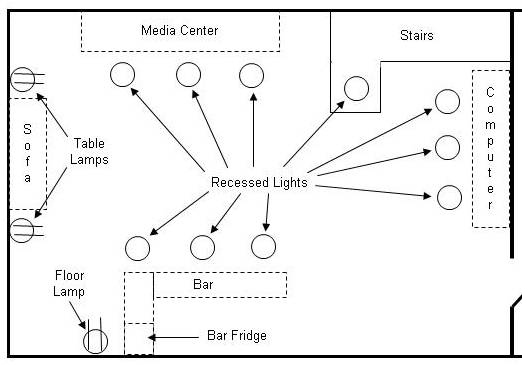
Figure 2 - Rough plan of the electrical requirements for new living space
There are 3D design software packages now available that are very easy for any individual to use to design and/or decorate new space. It is relatively inexpensive and well worth the investment.
From this rough plan you can create a list defining the electrical requirements for the finished basement, attic or addition. At this time do not concern yourself with switch locations or the exact locations of light fixtures or other electrical devices.
Electrical Requirements For Our Finished Basement |
|||
Shared 15 Amp Circuits |
|||
|
|
|
|
Recessed Can Lights |
|
|
|
Media Center (TV, Stereo / CD Player, |
|
|
|
Computer System / Printer / Fax Machine |
|
|
|
Floor Lamp |
|
|
|
Table Lamps |
|
|
|
Total Amperage: |
31 |
||
Number of 15 amp shared circuits Total Amperage ÷ 15 |
|
||
Individual 15 Amp Circuits |
|||
Bar Refrigerator |
|
||
Number of 15 amp individual circuits: |
|
||
Total Number of 15 Amp Circuits Required: |
4 |
||
It is not necessary to know the exact amperage that you will need for each item. As an example for each light bulb, use 1 amp. One amp will allow for a 100 watt light bulb.
If you are in doubt about the amperage needed for any specific electrical item you can usually find the wattage of the item with an online search. If you know the watts (power consumed), you can determine the amperage by dividing the watts by 120. As an example, an item that consumes 900 watts will require 7.5 amps.
Certain items should be powered from their own circuits and not be shared with other electrical items. Appliances such as electric baseboard or radiant heaters, refrigerators, microwaves, dishwashers and washing machines should have their own 15 or preferably 20 amp circuits. Of course, appliances such as ranges, cooktops, ovens, water heaters and laundry dryers require specialty high amperage circuits.
Once you know how many circuits you will need you must determine where you will obtain the power from. In most cases, with a finished basement, the electrical service is in the basement area which usually makes it quite accessible. If however, this is an addition, getting the electrical power to the new space could be a challenge. A challenge that must be solved. As the possible situations are endless it is impossible to tell you how to get from point A to B. That being said, some considerations include, running a conduit underground from one side of the house to the addition, going up through attic space and then down again. I can almost assure you that there is a way to get from point A to B - you just have to be creative and it may not be the shortest distance!