
Wires that arc and spark in a home are not an uncommon problem. According to reports gathered through-out the USA, arcing and sparking in home wiring cause more than 35,000 home fires each year claiming countless lives and injuries.
A new electrical safety device for homes, called an arc fault circuit interrupter or AFCI, Figure 1, is expected to provide enhanced protection from fires resulting from these unsafe home wiring conditions.
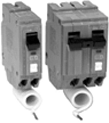
Figure 1 - Arc Fault Circuit Interrupter (AFCI)
Unlike GFCIs, arc fault circuit interrupters protect your home from wires sparking between each other. GFCIs protect individuals against shock.
Typical household fuses and circuit breakers do not respond to early arcing and sparking conditions in home wiring. By the time a fuse or circuit breaker opens a circuit to defuse these conditions, a fire may already have begun.
Several years ago, a CPSC study identified arc fault detection as a promising new technology. Since then, CPSC electrical engineers have tested the new AFCIs on the market and found these products to be effective.
Arcs are the result of wire that has had its insulation damaged. This can occur in the wire manufacturing process, during installation as the cables are pulled into their positions or from damage do to screws and nails.
Note: If a nail, screw or other metal object actually shorts the wires, this is not an arc but a short and any normal breaker will react to such an event.
Scenario:
It is not uncommon, after the construction or during renovation of a home, to accidentally put a nail through an electrical cable. The problem is usually solved by identifying the screw or nail and resetting the breaker. Because the screw or nail is no longer shorting the wires, the circuit works perfectly. But the insulation on the wires does not go back to its pristine state before it was penetrated by the screw or nail. The situation is that you now have electrical wires buried in the walls of your home that have damaged insulation and could eventually arc, as shown in Figure 2.
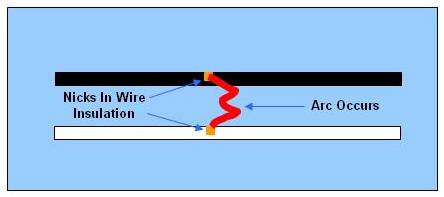
Figure 2 - Nicks in insulation provide a potential for arcing
Requiring AFCI's:
AFCIs are already recognized for their effectiveness in preventing fires. The most recent edition of the National Electrical Code (NEC), the widely-adopted model code for electrical wiring, has required AFCIs for bedroom circuits in new residential construction, effective January 2002. It is expected that AFCI circuit breakers will be required for all receptacles in a home with the publishing of the 2008 NEC manual.
Update: The 2008 National Electrical Code®, Combination Type AFCIs are required in dwelling unit family rooms, dining rooms, living rooms, parlors, libraries, dens, bedrooms, sunrooms, recreation rooms, closets, hallways, or similar rooms or areas.
Please see the NEC® for the exact wording of the requirements. Some areas may adopt other effective dates and may expand the requirements beyond the bedroom circuits. Contact your local authority having jurisdiction to verify code requirements for your area.
Future editions of the code, which is updated every three years, could expand coverage.
AFCI's vs. GFCI's:
AFCIs should not be confused with ground fault circuit interrupters or GFCIs. The popular GFCI devices are designed to provide protection from the serious consequences of electric shock.
While both AFCIs and GFCIs are important safety devices, they have different functions. AFCIs are intended to address fire hazards; GFCIs address shock hazards. Combination devices that include both AFCI and GFCI protection in one unit will become available soon.
AFCIs can be installed in any 15 or 20-ampere branch circuit in homes today and are currently available as circuit breakers with built-in AFCI features. In the near future, other types of devices with AFCI protection will be available.
Should You Install AFCI's?
You may want to consider adding AFCI protection for both new and existing homes. Older homes with ordinary circuit breakers especially may benefit from the added protection against the arcing faults that can occur in aging wiring systems.
For more information about AFCIs, contact an electrical supply store, an electrician, or the manufacturer of the circuit breakers already installed in your home. Sometimes these components can be replaced with AFCIs in the existing electrical panel box.
Be sure to have a qualified electrician install AFCIs; do not attempt this work yourself. The installation involves working within electrical panel boxes that are usually electrically live, even with the main circuit breakers turned off.