
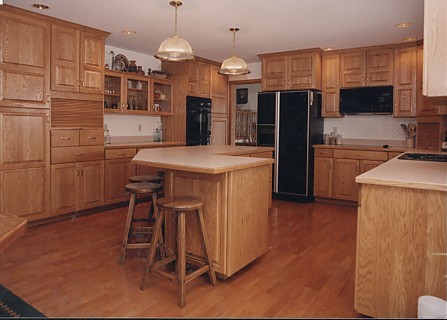
Figure 1 - Kitchen cabinets
The cabinets that you choose for your kitchen remodeling project can easily amount to 60% of the total amount spent on the project.
In home improvement projects, a kitchen remodel is one of the most expensive home improvement projects that can be undertaken and the cabinetry (Figure 1) is the single most expensive item in a kitchen remodel.
There are many options, material quality levels, styles, joinery, hardware, trims, and finishes. Considering that the vast majority of kitchen cabinet installations have a minimum 35-year life, it is important to understand and consider your requirements both in functionality and design before you purchase.
You can design and see your new kitchen in 3D with inexpensive software packages that are available for your home computer. As the cabinets are a large investment it is worth the effort and expense to see what your kitchen will look like before you order or buy!
Kitchen cabinets have an enormous spread in pricing – from $80 a lineal foot for laminate faced, self-assemble to $300 a lineal foot for hardwood doors, glass insets, and ceiling trims. If you go to a custom cabinet maker, you can easily pay well over $500 a lineal foot.
View more than 50 kitchen remodeling pictures
Because of this spread in price, it is important to set a top amount that you can afford. Then you consider the cabinet designs available up to that price point. There are a few additional items to consider.
Note: Unless specifically indicated the price per lineal foot does not include the countertop, cabinet removal or cabinet installation.
Additional information on: Kitchen countertops
To estimate the costs of your kitchen cabinets measure the length of the area that will have base cabinets, the ones that sit on the floor, and the length of the wall cabinets. Add these two numbers together and you have the number of lineal feet of required cabinets. If it is your intent to install a pantry or other cabinet that is floor to ceiling, include the length dimension in both the base and wall cabinet number.
Most home centers and kitchen cabinet specialty retailers will post an average lineal price for each design and quality. The lineal foot price indicated is usually based on a 10-foot long, straight wall configuration, (no corner cabinets required or included or glass doors). It will not include any trim or cabinet options and in many cases will not include doorknobs, or drawer pulls.
As a rule of thumb, you can double the lineal foot price of the cabinets to arrive at the total cost of the project, installed, not including the countertop.
There are 3 basic cabinet types:
- Stock:
- Semi-Custom:
- Custom Cabinets:
Stock cabinets come in 2 styles, assembly required and pre-assembled and are based on standard sizes with few options for base and wall units (custom sizes are not available). In order to have the cabinets fit you purchase the standard sizes to come as close as possible to your finished wall dimension and then install filler strips in the spaces that are not covered by the cabinets.
One of the largest savings made by the manufacturer is in freight. Cabinets that are not assembled take up about 10% of the space in a freight trailer than finished (semi-custom) cabinets. Hence, the freight cost for a cabinet, of a particular size, that is not assembled, is about a tenth of the price of a cabinet that is.
These cabinets are mass produced and are shipped assembled, but have a lot more options such as sliding drawers, multi-door pantries, a variety of trim material and specialty cabinets, (these cabinets are only available in standard sizes). In many cases the quality level of the materials used and the joinery is of a higher quality than the stock
cabinets.
Custom cabinets provide complete flexibility in cabinet sizes, materials, options and configurations.
It may be noted that almost all cabinets, no matter what the price point, are built using a veneered MDF board. MDF has the advantage of being very stable and will not warp.
The veneer can be a synthetic laminate or hardwood.
The lineal per foot cost is in the doors and hardware. Doors can be made of veneered MDF or hardwoods that are richly stained.
Luxury door hardware, such as hinges, knobs, and pulls can add as much as $50 to the price of a specific cabinet.
Drawer slides are also an important price driver. Quality drawer slides makes a major difference to the price of a cabinet.
When you are shopping for your cabinets, pay special attention to the hardware that is used and fabrication techniques. Make sure you are comparing similar qualities when looking at best
price.
If you are looking at a DIY project, consider the options of buying cabinets and then adding drawer and cupboard organizers that are purchased separately. Usually purchasing this type of hardware separate from the cabinets can provide a substantial cost saving. This also applies to draw pulls and other
If you have good wood working skills you can consider making your own kitchen cabinets, providing a substantial saving.
Additional information on: Making your own kitchen cabinets